AI document manager for commercial lending
Sole Product Designer
Product strategy, UI/UX, Prototyping
AVANA Companies, Nitsa AI
Sep 2025 – ongoing




Collaboration
Project Manager
Engineering
Lending team
context
Nitsa AI is AVANA Companies’ deal-management platform for commercial lending. Its document manager handles the flow of borrower documents every deal depends on — tax returns, financial statements, debt schedules — with AI-assisted classification.
I’m the sole designer on the team, working end-to-end with a PM, engineers, and the lending team — processors, underwriters, and portfolio managers. What started as document management is now growing into a full deal-management system.
problem
Every document arrived by email. Processors downloaded attachments, renamed them to a naming convention, filed them into Box folders by hand, tracked completeness in Excel checklists, and emailed “docs due” lists to borrowers.
Hours of skilled analyst time went to filing, misfiled or missed documents stalled deals, and there was no single source of truth for what was outstanding.
Research & Validation
Moderated usability testing
Hallway tests with the lending team
Post-release stats & behaviour analysis
Competitor analysis
Stakeholder feedback loops
RESULTS & impact
7 min → 30–60 sec
to review and confirm a document now — with 100–150+ documents per deal
70%
of documents are confirmed without a single edit to the AI’s suggestion
Solution overview
Action
Designed an AI-assisted classification workflow with a human in the loop: the AI suggests the document type, owner, period, and deal — an analyst confirms or corrects in one action. One workflow replaced four manual tools: email triage, the Excel checklist, hand-filing in Box, and status emails.
what was built (high level)
Classification workspace
PDF preview beside the AI suggestion with a confidence badge — confirm, or reject with a reason, then jump to the next document in the queue
Incoming files hub
Every uploaded document across deals with its AI classification status, document type, linked deal, and assignee
Document checklist
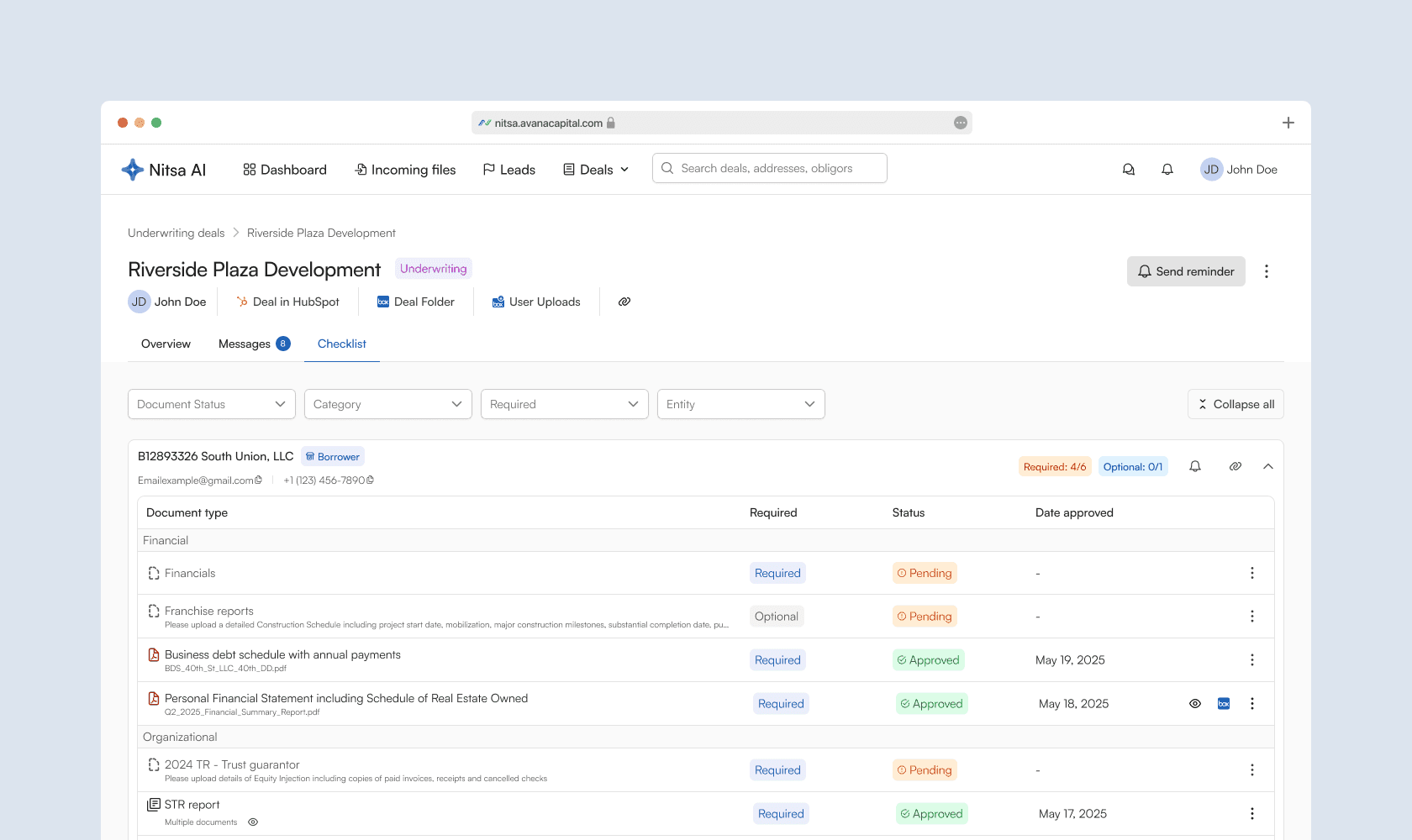
Required vs optional documents per borrower and guarantor, auto-updated as files are confirmed

Deep dive 1
The classification workspace
problem
This one screen had to solve two hard problems at once: earning trust in AI on financial documents — where a misclassified tax return isn’t tolerable — and staying fast across the 100–150+ documents a single deal can carry.
I designed it so the AI proposes and the analyst decides: every suggestion ships with a confidence level, every decision feeds the learning loop, and the whole thing runs as a queue instead of a file browser.
what I Designed
Confidence badge on every suggestion → analysts see at a glance how much to trust each classification
One-action confirm, then next → the common case is a single click across a deal’s 100+ documents
Structured rejection reasons → incorrect details, poor quality, duplicate, not relevant — data that feeds the AI learning loop
Per-deal queue + edge cases → a “1 of 3 in this deal, 10 remaining” sidebar, plus exact-duplicate detection and multi-type files
Validation
(usability testing & release stats)
Trust grew with transparency
Visible confidence levels made it easier for analysts to accept the AI’s suggestions
The common case is one click
70% of documents are confirmed without any edits to the AI classification
Review became a flow
Handling a document dropped from 5–7 minutes to about one
Tested with the real team
Moderated usability tests with processors and portfolio managers shaped the flow


Deep dive 2
The checklist that replaced the spreadsheet
problem
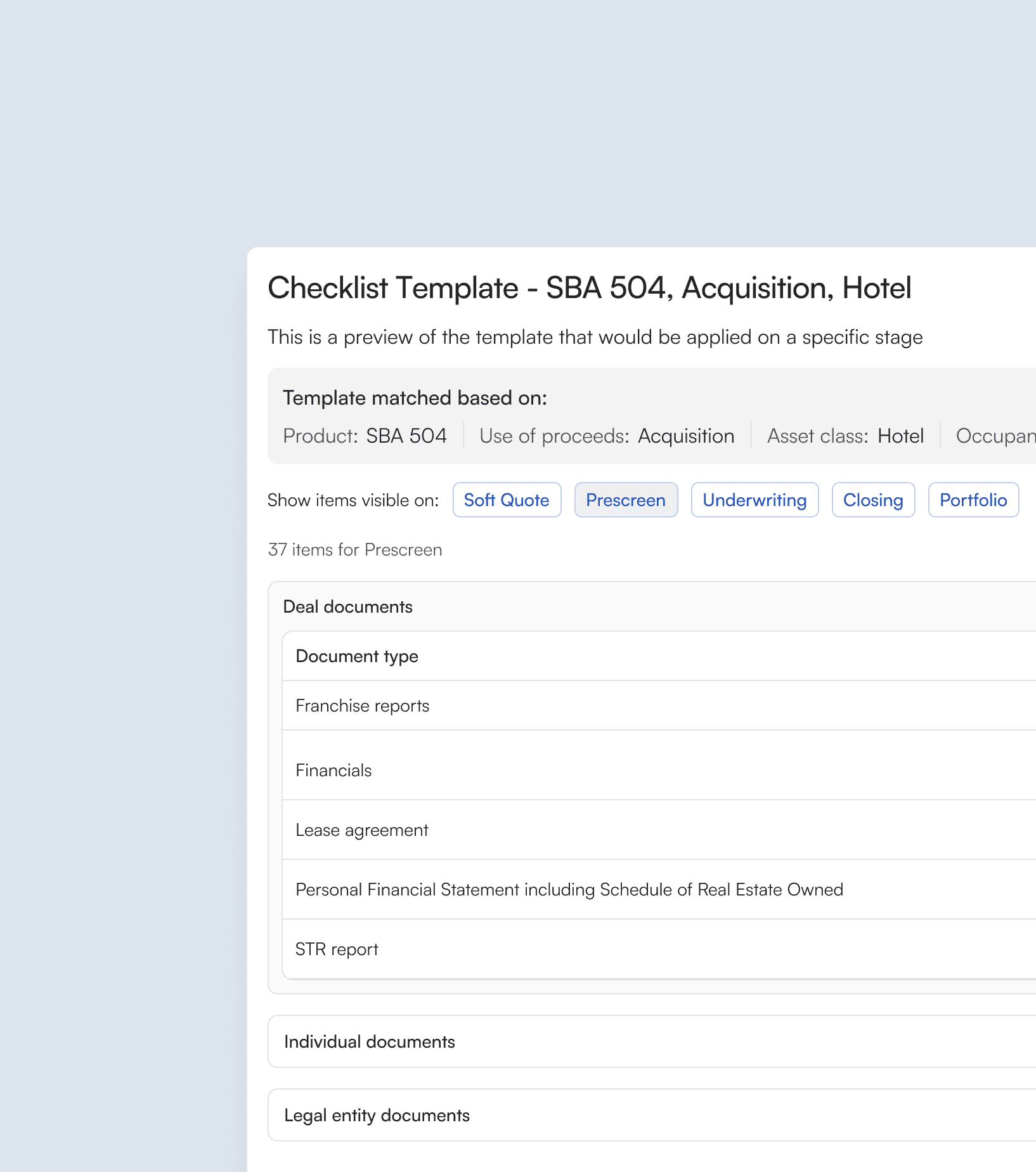
Completeness used to live in an Excel sheet, with “docs due” lists emailed out by hand. Nobody had a live view of what a deal still needed or who owed it — and requirements shift with each deal’s configuration.
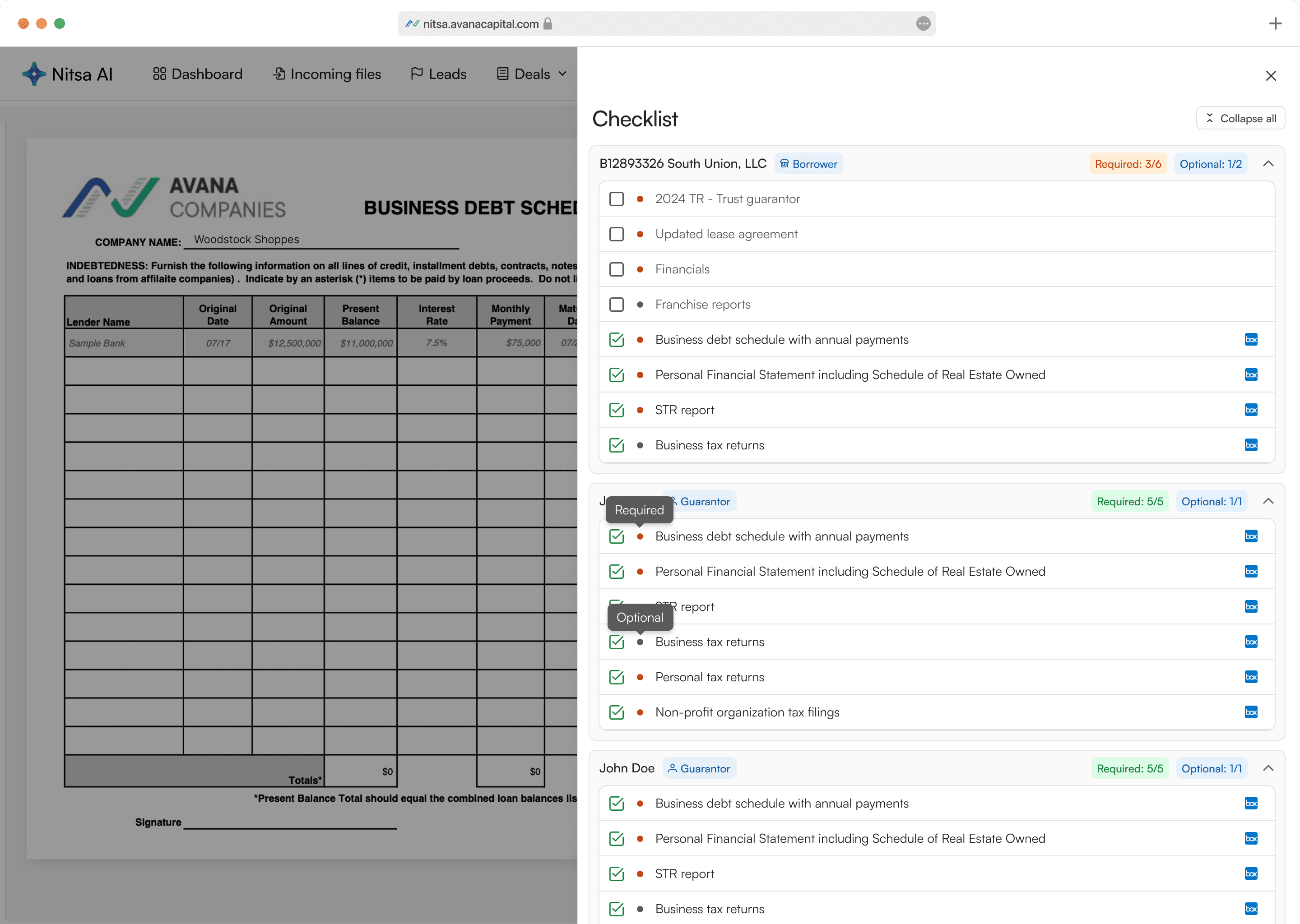
I designed a checklist tied to each deal: required vs optional documents per borrower and guarantor, updating itself as files are confirmed in review.
what I Designed
Required vs optional per role → each borrower and guarantor gets its own document set, matching how deals are structured
Auto-updating status → items complete themselves as documents are confirmed, so the list is always current
Single source of truth → replaces the Excel sheet, so everyone sees what’s pending and who owns it
Powers borrower requests → the same checklist drives what’s asked for through the Obligor portal, not manual emails
Validation
(usability testing & release stats)
Completeness at a glance
Anyone can see what a deal still needs without opening a spreadsheet
Ownership is clear
Required-vs-optional per borrower and guarantor makes it obvious who owes what
Fewer status emails
Auto-updating status cut the manual “docs due” follow-ups
Ready for the portal
The same checklist will drive document requests in the borrower-facing Obligor portal


Results & what’s next
iteration
Not everything survived the first version. Deals move through stages, and v1 gave every stage the same document-management design — but after closing, a deal enters Portfolio and lives for years, collecting documents annually until the loan is paid off.
A stage-based structure couldn’t express that yearly rhythm — so I redesigned Portfolio as structurally different: documents grouped by year until the loan is paid off, with the same confirm-and-reject review motion carried over.
outcomes
& next steps
Shipped and used daily
The lending team runs every active deal’s documents through the manager
Still improving after release
Ongoing stats and behaviour analysis keep feeding design updates
Growing into deal management
Next up: the borrower-facing Obligor portal and stage-based tasks beyond documents